


Views: 0 Author: Site Editor Publish Time: 2026-09-05 Origin: Site


Managing indoor air quality forces facility managers and homeowners to tackle two distinct problems at once. You have to capture physical particulate matter like dust, dander, and pollen while simultaneously neutralizing molecular pollutants such as volatile organic compounds (VOCs), odors, and toxic gases. Standard HVAC systems and standalone air purifiers rarely have the physical housing depth to fit separate, dedicated HEPA filters alongside deep-bed carbon filtration units. This spatial constraint leaves a massive gap in air treatment capabilities.
The activated carbon panel air filter bridges this exact gap. It consolidates mechanical filtration and chemical adsorption into a single footprint. By leveraging a dual-media construction, this filter addresses both physical debris and chemical contaminants without requiring extensive equipment modifications. You get a streamlined approach to air purification that fits directly into standard filter racks.
Dual-Mechanism Filtration: Combined panels utilize mechanical filtration (pleated media) to trap physical particles and chemical adsorption (activated carbon) to act as a molecular sponge for gaseous pollutants.
Design Trade-offs: Selecting the right filter requires balancing carbon density (for odor capacity) against airflow resistance (pressure drop) and particulate capture efficiency (MERV rating).
Structural Variations: Form factors like the honeycomb activated carbon filter prioritize gas adsorption, while an activated carbon pleated pre filter prioritizes airflow and particulate capture.
Maintenance and Economic Realities: Combined filters often require more frequent replacement cycles, as the carbon media typically reaches saturation before the particulate media reaches its dust-holding capacity, requiring the entire unit to be replaced.
Airborne particles behave differently depending on their specific size, mass, and velocity. Synthetic or fiberglass media captures these physical particles through three primary mechanical mechanisms. Understanding these mechanisms helps you realize why pre-filtration matters so much in a combined panel.
Interception: This occurs when a particle follows the airstream but comes close enough to a filter fiber to adhere to it. This mechanism mostly affects medium-sized particles like heavy dust and lint.
Impaction: Larger, heavier particles cannot navigate the winding, tortuous paths of the airflow through the filter matrix. Their own inertia causes them to crash directly into the fibers, trapping them instantly.
Diffusion: This targets the smallest, ultrafine particles. These tiny particles bounce erratically due to Brownian motion, colliding with gas molecules. This erratic, zigzag path dramatically increases their chance of colliding with a filter fiber as they pass through the media.
The physical media acts as the first line of defense in a combined panel. It traps larger dust, hair, and debris before they can reach the sensitive carbon layer. This sequential capture prevents larger particles from prematurely blinding the microscopic pores of the carbon media. Blinding physically blocks the surface area required for gas adsorption. Effective mechanical capture ensures the carbon substrate remains open, active, and capable of neutralizing odors.
Particulate filters cannot capture gases. Gases and odors require chemical adsorption. Adsorption is distinctly different from absorption. In absorption, a substance permeates the entire volume of another material, much like water soaking into a standard sponge. In adsorption, gas molecules adhere only to the surface of the media.
Volatile organic compounds (VOCs), hazardous fumes, and odor molecules stick to the high-surface-area micropores of the carbon substrate. The carbon functions as a molecular sponge, utilizing Van der Waals forces to bind the gas molecules tightly to the carbon surface. The activation process—usually involving steam or heat treatment—creates millions of tiny pores in the carbon, giving a single gram of activated carbon a surface area larger than a tennis court.
The effectiveness of this chemical process depends heavily on dwell time. Dwell time, often referred to as residence time, is the specific duration the contaminated air remains in direct contact with the carbon material. The velocity of airflow passing through the panel dictates the effectiveness of odor and toxic gas removal. If the air handler pushes air too quickly, gas molecules slip past the carbon without adhering. Slower airflow increases dwell time, allowing the chemical bonds to form. Balancing airflow velocity with sufficient carbon mass determines the overall performance of the filtration system.
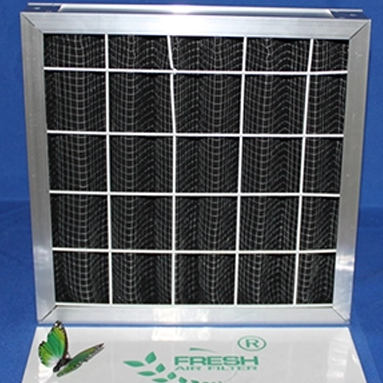
Manufacturers construct the activated carbon pleated pre filter using durable synthetic non-woven media. During production, this media is impregnated or heavily coated with finely milled activated carbon dust. The pleating process folds the media into V-shapes, which significantly increases the overall surface area exposed to the incoming airstream. This expanded surface area allows for better particle capture while keeping static pressure relatively low.
This filter type is best suited for high-airflow HVAC systems requiring standard MERV ratings, typically falling between MERV 8 and MERV 11. The primary use case involves environments with light-to-moderate odor control needs. Common applications include residential homes dealing with occasional cooking smells, light pet odors, or seasonal pollen. The low airflow resistance ensures the HVAC blower motor operates efficiently without overheating.
The main trade-off of this design involves the total carbon weight. Because the carbon is finely milled and applied merely as a surface coating, the total mass is relatively low. This lower carbon weight inherently limits the lifespan of the filter. It also restricts the capacity for heavy VOC environments. High concentrations of gases will saturate the thin carbon layer rapidly, requiring immediate replacement.
For more demanding environments, the honeycomb activated carbon filter offers a drastically different structural approach. This filter features a rigid grid or honeycomb structure made of plastic or heavy-duty cardboard. Manufacturers fill these individual geometric cells with granular or pelletized activated carbon. A thin particulate mesh or scrim often backs the grid to keep the carbon granules securely in place and prevent dust shedding.
This robust design is ideal for environments where heavy odor, chemical mitigation, or hazardous fume extraction is the primary success criterion. Industrial settings, commercial laboratories, or homes situated near heavy outdoor pollution benefit most from this structure. In these specific setups, particulate filtration is considered secondary. Often, a separate, dedicated HEPA filter handles the fine dust, leaving the honeycomb panel to focus entirely on gas adsorption.
The trade-off here centers heavily on airflow and particulate efficiency. The higher carbon mass significantly increases the total VOC capacity. Pushing air through dense granular beds induces a much higher pressure drop. The blower motor must work considerably harder to force air through the pellets. This design offers lower standalone particulate efficiency compared to tightly pleated synthetic media, making pre-filtration a necessity.
Evaluating a carbon filter requires looking closely at carbon density. You measure this density in grams per square foot or by the total physical weight of the filter. A heavier filter generally contains more carbon material. More carbon translates directly to more micropores available for gas adsorption, extending the time before the filter reaches full saturation.
There is a direct correlation between carbon mass and increased static pressure. Static pressure, measured in inches of water column, represents airflow resistance. A dense bed of carbon pellets restricts air movement severely. This restriction places potential strain on blower motors, especially older Permanent Split Capacitor (PSC) motors. If a motor lacks the power to overcome this resistance, total airflow drops. Poor airflow leads to inadequate heating, cooling, and overall air circulation. You must balance the need for aggressive odor removal against the mechanical limits of your specific air handler.
Filter Structure Type | Relative Carbon Density | Airflow Resistance (Pressure Drop) | Primary Application Strength |
|---|---|---|---|
Pleated Impregnated Media | Low (Coated Dust) | Low to Moderate | Particulate capture, light ambient odors |
Honeycomb Granular Grid | High (Pellets/Granules) | High | Heavy VOCs, strong chemical fumes |
Adding carbon media directly impacts the MERV rating of a filter. The Minimum Efficiency Reporting Value (MERV) measures how effectively a filter captures specific particle sizes ranging from 0.3 to 10 microns. When you combine dense particulate media with carbon layers, airflow becomes highly restricted very quickly.
Most standard combined panels max out around MERV 13. Pushing the particulate efficiency higher would require much tighter media fibers. Combining tighter fibers with a restrictive layer of carbon creates an unacceptable pressure drop for standard residential and commercial systems. Manufacturers engineer a deliberate compromise. They balance a mid-range MERV rating with just enough carbon to handle moderate odors. If your environment demands true HEPA efficiency alongside heavy gas removal, you usually need separate, dedicated filter stages powered by a high-velocity motor.
Standard activated carbon performs exceptionally well against common, everyday VOCs. It easily captures smoke, pet odors, cooking smells, and standard household cleaning fumes. The micropores created during the carbon activation process are perfectly sized to trap these larger, heavier gas molecules effectively.
Standard carbon has distinct chemical limitations. It is highly ineffective against certain low-molecular-weight gases. Formaldehyde, ammonia, and certain sulfur compounds are prime examples. These molecules are too small and volatile to remain trapped by standard Van der Waals forces. To capture these specific gases, the carbon requires targeted chemical treatment. This process, known as chemisorption, uses impregnated carbon treated with substances like potassium permanganate. The chemical coating reacts with the specific gas, altering its molecular structure and binding it permanently to the filter media.
Contaminant Type | Standard Activated Carbon Effectiveness | Treated Carbon (Chemisorption) Requirement |
|---|---|---|
Pet Odors & Cooking Smells | High | Not Required |
Tobacco Smoke (Gases) | High | Not Required |
Formaldehyde | Low | Required (Potassium Permanganate) |
Ammonia | Low | Required (Acid-Treated Carbon) |
Combined filters face a significant disparity in media lifespan. The mechanical particulate media might easily last three to six months before reaching its maximum dust-holding capacity. In stark contrast, the carbon media can saturate in just four to eight weeks, depending heavily on the environmental VOC load and humidity levels.
This disparity creates a tangible economic trade-off. With a combined filter, users must discard the entire unit once the carbon is saturated. You end up throwing away still-viable particulate media. This dynamic increases material waste and accelerates replacement frequency.
Establish replacement schedules based strictly on odor breakthrough. Do not rely on a visual inspection of dust accumulation. If you begin to smell odors returning to the space, the carbon is full, regardless of how clean and white the pleated media looks. Replacing the filter at the first sign of odor breakthrough ensures continuous protection against gases.
A saturated carbon filter presents a unique and serious risk called desorption. When the carbon reaches its maximum capacity, it cannot hold any more gas molecules. Fluctuations in indoor temperature or humidity can break the weak physical bonds holding the VOCs. The filter then releases trapped VOCs back into the airstream. This off-gassing turns the filter into a secondary source of indoor pollution.
Mitigation requires strict maintenance logs and proactive monitoring. Track installation dates and expected saturation timelines meticulously. Utilize environmental sensors to detect baseline VOC increases in the room. If your indoor air quality monitor shows a sudden, unexplained spike in VOCs without a clear source, check your carbon filter immediately. A sour or sweet chemical smell emanating from the vents is a clear indicator of desorption.
Installing a high-density carbon panel in a system not rated for it carries severe mechanical risks. The increased pressure drop can drastically reduce airflow across the heat exchanger. In an air conditioning system, low airflow can freeze the evaporator coils solid. In heating mode, it can overheat the furnace, triggering safety shutoffs. The blower motor may burn out prematurely trying to overcome the extreme resistance.
Many users attempt DIY carbon filters, such as strapping loose carbon pads to standard box fans. While cheap, these uncalibrated builds lack predictable external static pressure (ESP). Engineered panels offer safer, tested airflow resistance. They provide reliable VOC removal without risking catastrophic equipment damage.
Verify the maximum allowable ESP of your air handler. Consult the equipment manual before upgrading from a standard pleated filter to a heavy-duty carbon panel. Ensure the system can handle the specific pressure drop of the new filter without compromising total airflow volume.
Audit your primary air quality complaint to determine if you need to target particulates, gases, or a combination of both before selecting a filter type.
Check your HVAC system's maximum allowable static pressure limits using a manometer to ensure compatibility with dense carbon media.
Select impregnated pleated filters for high-airflow, low-odor residential setups where particulate capture remains a high priority.
Deploy honeycomb granular panels for dedicated purification systems facing heavy chemical loads, strong odors, or fume extraction requirements.
Establish a strict maintenance log based on odor breakthrough rather than visual dust accumulation to prevent dangerous desorption and off-gassing.
A: While standard particulate filters often last 90 days, carbon panels usually require replacement every 30 to 60 days. This accelerated schedule is necessary to maintain effective odor adsorption. The exact timeframe depends heavily on the environmental VOC levels and the specific carbon density of the filter.
A: No. Carbon pleated filters typically achieve MERV 8 to MERV 13 ratings. They cannot capture ultrafine particles at the 0.3-micron level with the 99.97% efficiency rate of a true HEPA filter. They serve different primary functions in air purification.
A: Yes. Combining an activated carbon panel with a HEPA filter in a multi-stage air purifier represents the gold standard for indoor air quality. The HEPA filter handles ultrafine particulates, while the carbon acts as a molecular sponge for gases and odors.
A: Standard activated carbon does not capture carbon monoxide. Removing carbon monoxide requires specific catalytic oxidation processes or dedicated, robust ventilation strategies to introduce fresh outdoor air into the environment.
A: A sour smell indicates desorption and saturation. Trapped moisture and VOCs begin to off-gas back into the airstream because the carbon micropores are completely full. This smell is a definitive signal that the filter must be replaced immediately.
A: It depends on the use case. Honeycomb filters hold significantly more carbon mass, providing superior odor and chemical removal. Impregnated pleats offer better airflow and higher standalone particulate capture, making them better suited for standard HVAC systems.
