


Views: 0 Author: Site Editor Publish Time: 2026-06-23 Origin: Site


In extreme-heat filtration systems, the filter media rarely fails first. The true vulnerability lies in the sealant or gasket. These components degrade under intense thermal stress, leading to catastrophic bypass leakage. Standard polyurethane and epoxy sealants break down rapidly above 250°F (120°C). Selecting the wrong high-temperature sealant results in outgassing, structural cracking during thermal expansion, compromised cleanroom integrity, and costly production downtime.
Specifying a High Temperature HEPA Filter requires a rigorous evaluation of sealant chemistry, curing requirements, and mechanical compatibility with the filter frame and media. You must understand how different materials react to heat spikes and continuous thermal loads. This guide provides an evidence-based framework for evaluating and selecting the correct sealant for specific thermal applications, ensuring your filtration system maintains absolute integrity under the harshest conditions.
Temperature Thresholds Dictate Chemistry: RTV silicone is the industry standard for continuous operating temperatures up to 500°F (260°C), while ceramic or glass-pack seals are mandatory for environments exceeding 500°F up to 750°F (400°C).
Thermal Expansion is the Primary Risk: The selected sealant must accommodate the differing thermal expansion rates of the metal frame and the filter media without shearing or cracking.
Curing Realities Impact Installation: High-temperature silicone sealants require specific ambient curing conditions (typically 50°F to 100°F and controlled humidity) before they can be subjected to operational heat loads.
Off-Gassing Considerations: In microelectronics or pharmaceutical applications, the sealant must be evaluated for volatile organic compound (VOC) release during initial heat-up cycles.
The core function of a sealant in high-heat filtration is achieved through a process called "potting." This involves securing the pleated filter pack to the top, bottom, and vertical sides of the rigid metal frame. The goal is to create an absolute, airtight barrier that forces all air through the media rather than around it. Without effective potting, the structural integrity of the entire filter assembly is compromised. The potting compound must flow deeply into the pleat folds during manufacturing. It encapsulates the delicate glass fibers, anchoring them firmly to the rigid frame walls. This mechanical bond must survive constant vibration from blower fans and the physical stress of thermal expansion.
When evaluating potting compounds, engineers look at viscosity and shore hardness. A sealant that is too thin will run out of the frame before curing. A sealant that is too thick will bridge across the pleats instead of penetrating them. The ideal potting material strikes a balance, filling every microscopic void between the media and the frame. This creates a monolithic block that resists air pressure and physical shock.
To prevent bypass leakage, the sealant must maintain continuous adhesion under high static pressure and fluctuating airflow requirements. As temperatures rise and fall, the sealant must grip both the frame and the media tightly. If the bond fails, unfiltered air bypasses the media, contaminating the clean environment. Maintaining this seal is critical for meeting stringent air quality standards. Bypass leakage is often invisible to the naked eye. A hairline crack in the sealant can allow millions of particles to pass through, instantly failing a cleanroom certification.
The physics of bypass leakage dictate that air will always take the path of least resistance. If a sealant pulls away from a stainless steel frame by even a fraction of a millimeter, the pressure differential across the filter will force air through that gap. This is why adhesion promoters and specific frame surface preparations are often used in conjunction with high-temperature sealants. The surface must be completely free of oils and oxidation before the sealant is applied.
There is a distinct mechanical difference between potting the horizontal media pack edges and securing the vertical frame sides. The top and bottom edges require deep potting to anchor the pleats. The vertical sides require side-potting to seal the ends of the media pack against the frame. Continuous potting on all four sides is absolutely required to eliminate any potential bypass pathways.
First, the bottom channel of the frame is filled with the liquid sealant.
The pleated media pack is carefully lowered into the wet sealant, ensuring the pleat tips are fully submerged.
The assembly is allowed to cure partially to lock the bottom edge in place.
The process is repeated for the top channel, creating a solid anchor for the vertical pleats.
Finally, the side channels are injected with sealant to close off the raw edges of the media pack.
Beyond sealing air leaks, the sealant provides essential structural rigidity to the filter pack. This is particularly important in high-velocity exhaust systems or sterilization tunnels where air pressure exerts significant force on the media. A robust sealant prevents the pleats from collapsing or shifting, ensuring consistent airflow and filtration performance. In a depyrogenation oven, for example, the air velocity can change rapidly as the oven cycles through heating and cooling phases. The sealant acts as a shock absorber, dampening the physical movement of the media pack and preventing the glass fibers from tearing.
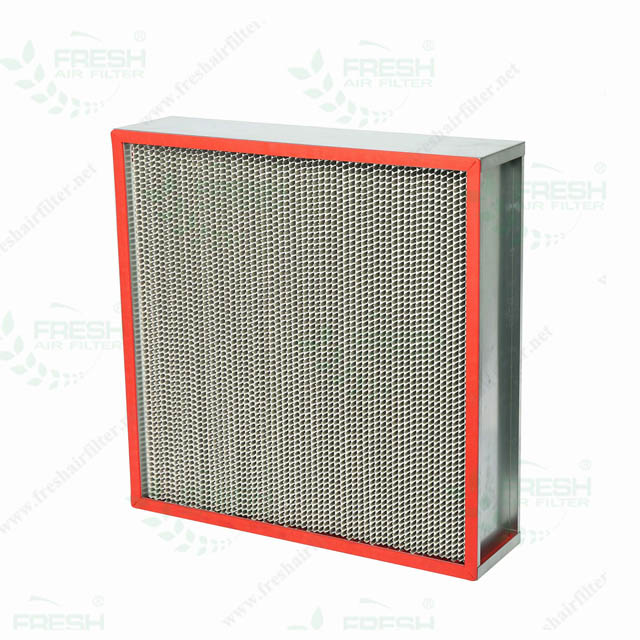
Room Temperature Vulcanizing (RTV) silicone is highly valued for its elasticity. This flexibility allows it to absorb thermal shock and mechanical vibration as the filter components expand and contract. It maintains a strong bond across a wide range of temperatures, making it a reliable choice for many industrial applications. The chemical structure of RTV silicone features a silicon-oxygen backbone, which provides inherent thermal stability compared to carbon-based polymers like polyurethane.
RTV silicone is best suited for pharmaceutical depyrogenation ovens, food processing facilities, and standard high-heat cleanroom environments. However, it has an absolute temperature ceiling. Prolonged exposure above 500°F causes the silicone to suffer embrittlement and eventual adhesion failure, leading to immediate bypass leaks. When silicone degrades from heat, it often turns brittle and chalky. It loses its ability to stretch, meaning the next thermal expansion cycle will likely shear the bond entirely.
For ultra-high-temperature applications, ceramic-based cements are utilized. These sealants cure into a hard, rigid mass capable of withstanding extreme heat that would destroy silicone. They provide excellent thermal resistance and structural support under continuous high-temperature exposure. Ceramic sealants are typically composed of alumina or silica compounds mixed with a liquid binder. As they cure, the binder evaporates, leaving a solid ceramic matrix.
The primary trade-off is that ceramic lacks elasticity. It is highly susceptible to cracking if the system experiences rapid thermal cycling or significant mechanical vibration. Once cracked, the seal is broken, and unfiltered air will bypass the media. To mitigate this, filters using ceramic sealants often employ specialized frame designs that minimize flex. The installation process must also be handled with extreme care, as dropping a ceramic-sealed filter can shatter the internal potting.
An alternative to liquid sealants involves packing the frame joints with high-density glass fiber high temperature media. This method relies on mechanical compression rather than chemical adhesion to create a seal. It is ideal for environments where chemical outgassing from silicones or ceramics is strictly prohibited, such as specific semiconductor manufacturing processes. The glass fibers are tightly wedged between the media pack and the frame, creating a dense labyrinth that traps particles.
This approach requires precise mechanical compression to maintain the seal effectively. There is also a higher risk of particulate shedding if the glass fiber packing is not properly encapsulated or if the compression degrades over time. Over thousands of thermal cycles, the metal frame can warp slightly. If the frame warps away from the glass fiber packing, the compression is lost, and a leak path opens. Therefore, mechanical seals require heavy-duty, rigid frames, often made from thick-gauge stainless steel, to prevent warping.
You must differentiate between the continuous operating temperature and peak temperature spikes. The sealant must be rated for the absolute peak spike, not just the average operating temperature. A sealant rated for 400°F continuous use will fail if the system regularly spikes to 600°F during cleaning cycles. Additionally, evaluate how the speed of temperature increase impacts the thermal shock on the sealant. Rapid ramp-up rates cause the metal frame to expand faster than the sealant can absorb the movement, leading to shear stress.
Facility managers must review the actual thermal profiles of their equipment. Do not rely solely on the setpoint temperature. Thermocouple data often reveals that areas near the heating elements experience localized temperature spikes far exceeding the average oven temperature. The filter sealant must be specified based on these localized maximums.
The chosen sealant must flow and penetrate the shallow, dense pleats of a high temperature mini pleat filter to ensure every fold is securely potted. If the viscosity is too high, it will not penetrate adequately. If it is too low, it may blind the media and increase pressure drop. Evaluate how sealant viscosity and potting height affect the active face area. Excess sealant squeeze-out can restrict airflow paths. Furthermore, evaluate the chemical bonding strength between the chosen sealant and the glass fiber media used in the filter pack.
Sealant Type | Max Continuous Temp | Max Peak Temp | Elasticity | Primary Application |
|---|---|---|---|---|
RTV Silicone | 500°F (260°C) | 550°F (287°C) | High | Depyrogenation Ovens |
Ceramic Cement | 750°F (400°C) | 800°F (426°C) | Low (Rigid) | Ultra-High Heat Exhaust |
Glass Fiber Packing | 1000°F+ (537°C+) | 1000°F+ (537°C+) | Moderate (Compression) | Zero-Outgassing Environments |
Silicone sealants will release siloxanes and smoke during their first high-heat cycle. This initial off-gassing is a normal part of the curing and stabilization process but poses a significant contamination risk. To mitigate this, implement a controlled "burn-in" or "bake-out" protocol outside of the critical cleanroom environment. This ensures the filter is fully stabilized before it is introduced to the primary process area. The burn-in process typically involves ramping the temperature up slowly over several hours, holding it at the maximum operating temperature, and then allowing it to cool.
During the burn-in phase, the ventilation system must exhaust the off-gassed compounds safely outdoors. If a new filter is installed directly into a cleanroom oven without a burn-in, the resulting smoke will coat the interior surfaces of the oven and potentially ruin the first batch of product. Always verify the manufacturer's recommended burn-in procedure for the specific sealant used.
The stainless steel or aluminum frame expands at a different rate than the glass fiber media and the sealant. This differential can shear the sealant bond, creating immediate bypass leaks. To mitigate this risk, specify floating media packs or highly elastic RTV silicones that can stretch and compress without breaking the hermetic seal during thermal cycling. Aluminum frames expand significantly more than stainless steel frames under the same heat load. If an aluminum frame is used with a rigid ceramic sealant, failure is almost guaranteed.
Engineers calculate the coefficient of thermal expansion for all three materials: the frame, the sealant, and the media. The goal is to ensure the sealant has enough elongation to bridge the gap created when the frame expands outward, pulling away from the media pack. High-quality RTV silicones can elongate up to 300% before breaking, providing a wide safety margin for thermal expansion.
Silicone sealants require proper curing time at specific ambient temperatures (50°F to 100°F) and humidity levels before installation. Premature heat exposure destroys the polymer cross-linking, causing bubbling and adhesive failure. During transport and housing installation, technicians must avoid applying mechanical leverage to the frame, which can shear the internal media-to-sealant bond. Ensure duct openings have proper high-temperature gaskets that match the filter's sealant capabilities to prevent secondary air leaks at the housing interface.
Store filters in a climate-controlled environment prior to installation.
Inspect the sealant lines visually for any signs of cracking or separation before mounting the filter.
Use a torque wrench to tighten housing clamps evenly, preventing frame distortion.
Never use the media face or the sealant edge as a handle when lifting the filter.
Performing a hot DOP/PAO aerosol leak test or a cold baseline test is necessary to verify sealant integrity before production begins. You must also evaluate the seal between the HEPA filter frame and the holding grid. Confirm that the housing gaskets perform reliably at the same maximum thermal limits as the internal potting sealant to ensure complete system integrity. Cold testing verifies that the filter was not damaged during shipping or installation. Hot testing verifies that the sealant and gaskets maintain their integrity under actual operating conditions.
Hot testing requires specialized aerosol generators and particle counters designed to withstand high temperatures. Standard PAO oil will burn off at high temperatures, so alternative challenge aerosols may be required depending on the specific temperature range. Always consult with a certified cleanroom testing professional to determine the appropriate testing methodology for your high-temperature system.
Audit your facility's thermal profiles to determine the absolute peak temperature spikes, not just the average operating baseline.
Select RTV silicone sealants for applications up to 500°F where vibration resistance and elasticity are required.
Specify ceramic cements or glass fiber packing for environments exceeding 500°F, ensuring the frame design minimizes mechanical flex.
Implement a strict burn-in protocol for all new silicone-sealed filters prior to cleanroom introduction to manage off-gassing.
Schedule post-installation integrity testing using appropriate hot or cold aerosol methods to verify the sealant bond before production begins.
A: Typically 500°F / 260°C for continuous operation, though specific formulations may handle brief spikes slightly higher. Beyond this, the silicone degrades.
A: Curing depends on humidity and temperature—usually between 50°F and 100°F—and can take 24 to 72 hours for a full, deep cure in a filter frame.
A: Yes, but testing must account for the thermal environment. Cold testing is standard, but specialized hot-testing protocols exist to ensure the sealant holds under expansion.
A: This is standard off-gassing from the high-temperature sealants and binders in the glass fiber media. A controlled burn-in cycle is required before cleanroom use.
A: Mini pleats use shallower folds and less sealant, offering lower pressure drop and higher airflow, while deep pleats use corrugated aluminum separators and deeper sealant potting for structural rigidity in harsh conditions.
A: Yes. The gasket sealing the filter to the housing must match the temperature rating of the filter's internal sealant, typically utilizing high-temp silicone, liquid gel seals, or woven fiberglass.
A: Yes. If the sealant viscosity is too low or application is uncontrolled, it can run up the media face (known as blinding the media). This reduces the effective filtration area, artificially raising the initial resistance and pressure drop.
