


Views: 0 Author: Site Editor Publish Time: 2026-06-16 Origin: Site


Upgrading supply air cleanliness in commercial and industrial facilities often forces a compromise between sub-micron particle capture and HVAC energy efficiency. Facility managers and mechanical engineers must meet stringent indoor air quality standards, specifically capturing fine particulate matter like PM1 and PM2.5, without inducing excessive static pressure drops. High resistance across the filter bank can overwhelm existing fan motors, restrict design airflow, and inflate operational utility costs. Balancing these demands requires moving away from standard pleated panels and adopting extended surface area solutions.
An F9 Pocket Filter serves as a critical final-stage or high-tier pre-filter solution. It utilizes extended surface area and advanced media to balance high-efficiency particle arrestance with sustainable aerodynamic performance. By distributing the air volume across deep, aerodynamically designed channels, this filtration method prevents the rapid pressure spikes typically associated with dense sub-micron media, solving the pressure drop dilemma for high-demand air handling units.
Standard Alignment: F9 pocket filters correspond to ISO 16890 ePM1 80-90% classifications, making them essential for environments requiring strict control over sub-micron airborne contaminants.
Media Architecture: Utilizing a multi-layer pocket filter media ensures depth filtration, significantly increasing dust-holding capacity while delaying the onset of terminal pressure drop.
Structural Selection: Choosing between rigid and soft pocket designs depends entirely on the system's airflow variability, pressure load requirements, and physical installation constraints.
The legacy EN 779 F9 standard maps to the current ISO 16890 framework as ePM1 > 80%. This classification indicates a high capacity for capturing combustion particles, atmospheric aerosols, viruses, and fine dust. Meeting this standard is critical for maintaining healthy indoor environments and protecting sensitive processes. The shift to ISO 16890 forces engineers to look at actual particulate mass rather than an arbitrary laboratory dust spot test. When a filter achieves an ePM1 rating of 80% or higher, it demonstrates the mechanical capability to arrest particles that are small enough to enter the human bloodstream or cause catastrophic defects in micro-manufacturing.
Several operational environments necessitate this level of filtration. Life sciences and healthcare facilities use them in pharmaceutical buffer zones, medical device manufacturing, and hospital operating theaters where airborne pathogens pose severe risks. High-tech and industrial manufacturing plants require them for precision electronics fabrication, automotive paint spray booths, chemical processing facilities, and food and beverage production lines. In these spaces, even a minor influx of PM1 contaminants can ruin a production batch or compromise a sterile field. Premium commercial real estate relies on them for high-occupancy offices aiming for WELL or LEED building certifications, where indoor air quality directly impacts tenant health and cognitive function.
The primary engineering challenge is the pressure drop dilemma. Achieving F9-level cleanliness without starving the HVAC system of air, exceeding static pressure limitations, or causing fan motor burnout requires careful filter selection and system design. When you increase the density of the filter media to catch smaller particles, you inherently increase the resistance to airflow. If the air handling unit (AHU) is not equipped with variable frequency drives (VFDs) or sufficient motor horsepower, the system will fail to deliver the required air changes per hour (ACH). This leads to stagnant air, poor temperature control, and potential coil freezing.
Comparison of Filtration Standards and Target Particles | |||
Legacy Standard (EN 779) | Current Standard (ISO 16890) | Target Particulate Size | Common Contaminants Captured |
|---|---|---|---|
G4 | Coarse > 60% | > 10 microns | Pollen, visible dust, hair, large spores |
M5 / M6 | ePM10 > 50% | < 10 microns | Cement dust, mold spores, heavy industrial dust |
F7 | ePM2.5 > 65% | < 2.5 microns | Pet dander, fine milling dust, bacteria |
F9 | ePM1 80-90% | < 1 micron | Combustion smoke, viruses, atmospheric aerosols |
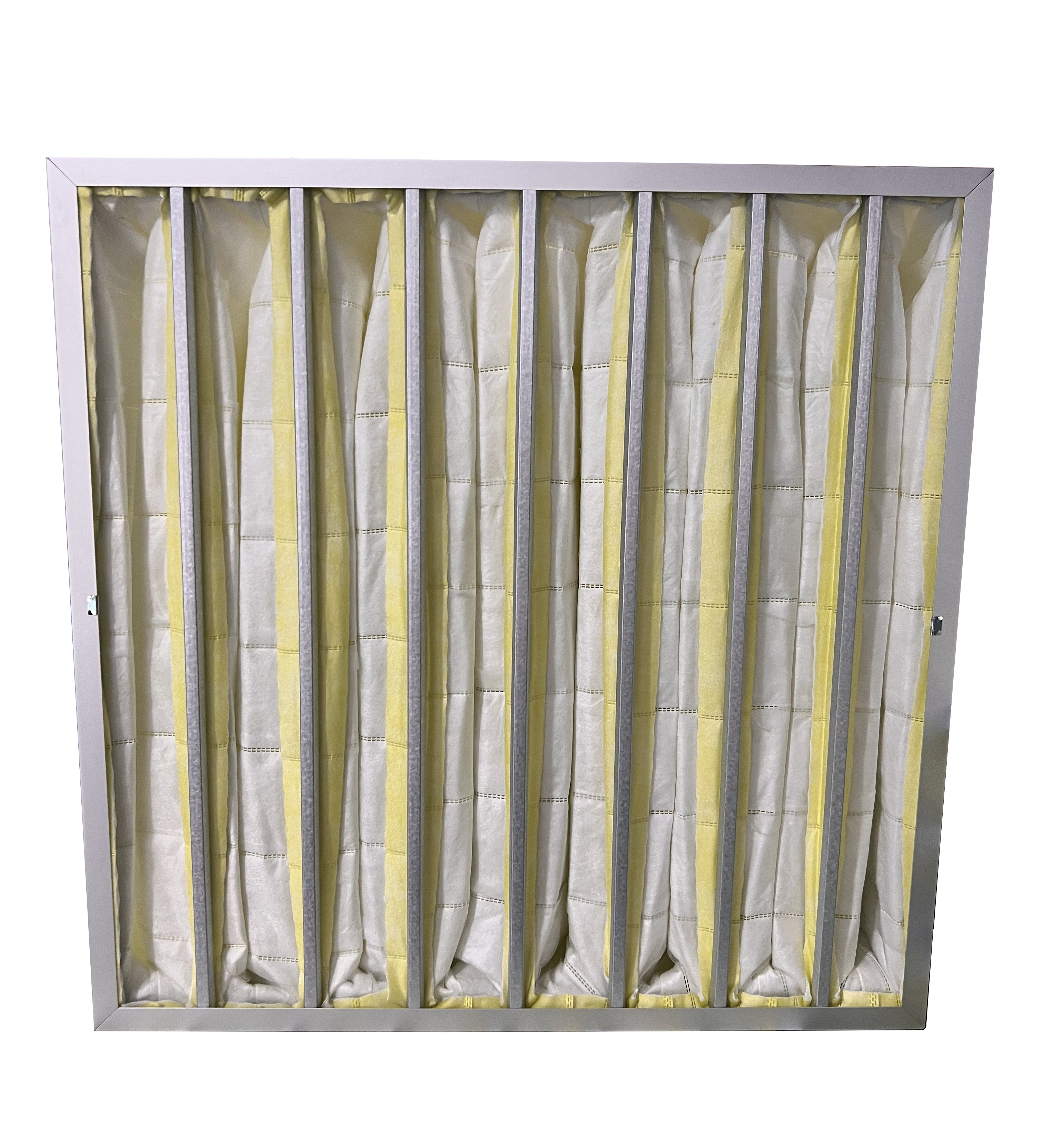
The multi-pocket configuration provides exponentially more active filtration area compared to flat panels or standard pleated filters. This extended surface area directly correlates with high dust retention capacity, allowing the filter to retain large volumes of particulate matter before reaching terminal resistance. By folding the media into deep V-shaped pockets, manufacturers can pack dozens of square feet of filtration material into a standard 24x24 inch frame. This massive surface area reduces the face velocity of the air as it passes through the media. Lower face velocity means lower initial pressure drop and a higher probability of particle capture via interception and diffusion.
Aerodynamically designed pockets, spacers, and channel tapered designs prevent adjacent bags from touching. This prevents pocket crowding or masking, ensuring uniform air velocity across the entire media surface and maximizing filtration efficiency. If the pockets are allowed to collapse against each other, the effective surface area is drastically reduced. The air will bypass the blinded sections and force its way through the remaining open media at a much higher velocity. This localized high velocity strips captured particles from the fibers and drives the pressure drop up prematurely. Quality pocket filters utilize internal stitching or sonic-welded spacers to maintain the aerodynamic profile of each pocket even under heavy airflow.
Comparing an F9 pocket filter to flat panel and standard pleated filters reveals significant advantages. Pocket designs offer up to 4-5 times the surface area. This geometry translates to a 300% increase in dust retention over flat panel alternatives. The resistance curves also show a slower progression of pressure drop over time in pocket configurations. A standard 2-inch pleated filter might load up and require replacement in three months, whereas a deep pocket filter in the same environment could easily last a year while maintaining a lower average pressure drop.
Inspect the AHU filter tracks to ensure they can accommodate the depth of the pocket filter (typically 12 to 36 inches).
Verify that there are no obstructions downstream, such as heating coils or dampers, that would interfere with the fully inflated pockets.
Install the filters with the pockets oriented vertically to prevent sagging and ensure proper airflow distribution across the media.
Check the perimeter gaskets for any signs of damage or compression set, replacing them if necessary to prevent air bypass.
Record the initial pressure drop across the filter bank using a calibrated manometer to establish a baseline for future maintenance.
A multi-layer pocket filter media utilizes a progressive density structure. A coarse outer layer captures larger particles, while a dense inner meltblown layer traps sub-micron particles. This depth filtration prevents premature surface blinding and skin-clogging. If a filter relies solely on surface filtration, the face of the media quickly becomes caked with dust, forming an impermeable layer that chokes off airflow. Progressive density media forces the air to navigate a tortuous path through increasingly tighter fibers. Large particles get stuck in the open outer layers, leaving the inner layers free to capture the fine PM1 contaminants. This maximizes the utilization of the entire media thickness.
Synthetic nonwoven composites offer distinct advantages over traditional fiberglass. They provide superior mechanical strength, moisture resistance, and the total elimination of fiber shedding, which is crucial for cleanroom pre-filtration. Fiberglass media, while effective at capturing particles, is brittle. During installation, handling, or under turbulent airflow, glass fibers can break off and enter the airstream. In a pharmaceutical or microelectronics facility, a shed glass fiber is just as damaging as the contaminant it was meant to catch. Synthetic media is spun-bonded or meltblown from polymers like polypropylene or polyester, creating continuous, unbreakable filaments that withstand rough handling and high moisture environments without degrading.
Synthetic nonwoven media often relies on electrostatic charges to enhance initial efficiency. However, this charge degrades over time. Evaluating real mechanical efficiency under ISO 16890.1-4 testing standards ensures consistent long-term performance. The ISO standard requires filters to be discharged using isopropanol vapor before testing to determine their true mechanical capture efficiency. This prevents manufacturers from artificially inflating their ratings with temporary static charges. When selecting a high efficiency nonwoven pocket filter, engineers must look at the discharged efficiency to guarantee the filter will perform adequately at the end of its service life, not just on day one.
Media Comparison: Synthetic Nonwoven vs. Traditional Fiberglass | ||
Feature | Synthetic Nonwoven Media | Traditional Fiberglass Media |
|---|---|---|
Mechanical Strength | High (tear-resistant, flexible) | Low (brittle, prone to tearing) |
Moisture Resistance | Excellent (hydrophobic) | Poor (can degrade or mat down) |
Fiber Shedding Risk | Zero (continuous filaments) | High (short, brittle fibers) |
Initial Pressure Drop | Generally lower | Generally higher |
Discharge Effect | Susceptible (requires mechanical verification) | Not applicable (purely mechanical) |
Soft-pocket bag filters excel in systems with stable, continuous airflow and standard pressure loads. They offer low shipping volumes due to collapsible, space-saving designs. They also provide a reduced storage footprint, ease of handling, and highly competitive initial procurement costs. For standard commercial office buildings or light manufacturing facilities where the AHU runs at a constant volume 24/7, soft pockets are highly effective. The continuous airflow keeps the pockets inflated and separated, allowing the media to perform as designed. Maintenance teams appreciate the lightweight nature of these filters, making change-outs faster and less physically demanding.
However, they carry the risk of pocket deflation, sagging, or fluttering during system shutdowns or variable air volume (VAV) fluctuations. This movement can dislodge captured particulate and cause re-entrainment. When a VAV system ramps down the fan speed to save energy, the reduced air pressure may not be enough to keep the soft pockets fully inflated. The bags can sag, touch each other, and blind off surface area. When the fan ramps back up, the sudden rush of air snaps the pockets open. This violent fluttering action acts like shaking a dusty rug, knocking dirt off the media and pushing it downstream into the supply air.
Rigid internal supports, aerodynamic spacers, or molded plastic headers maintain pocket shape regardless of air velocity or sudden system start-stops. This stability is crucial for consistent performance under variable airflow. Rigid pocket filters utilize a robust frame, often made of galvanized steel or high-impact plastic, with internal wire grids or plastic struts that hold each pocket open permanently. Even when the AHU is completely shut off, the filter maintains its aerodynamic profile. This eliminates the risk of pocket crowding and prevents the re-entrainment of dust during fan cycling.
Rigid designs are mandatory for systems with strong, variable air velocities, high micro-fine dust concentrations, or frequent on/off cycling, such as gas turbines and heavy industrial processes. They serve as highly reliable final filters when HEPA-grade filtration is not structurally or financially viable. In a gas turbine intake, for example, the air velocity is immense, and the system experiences massive pressure pulses. A soft pocket filter would be torn to shreds in hours. Rigid pocket filters withstand these extreme aerodynamic forces, protecting the turbine blades from fouling and erosion while maintaining a manageable pressure drop.
Calculating the energy penalty of pressure drop is essential for any facility manager looking to optimize operational budgets. The fan motor in an AHU consumes a massive amount of electricity, and its energy draw is directly proportional to the resistance it must overcome. Choosing a high-efficiency filter with a lower initial resistance saves kilowatt-hours over its operational lifespan. This energy efficiency offsets the higher initial cost of premium media. When a filter loads with dirt, the pressure drop increases, forcing the VFD to ramp up the fan speed to maintain the setpoint airflow. This exponential increase in energy consumption often dwarfs the actual purchase price of the filter itself.
Frequently replacing lower-capacity filters incurs labor, procurement, and disposal costs. The extended lifecycle of a high-capacity filter reduces these expenses significantly. Every time a maintenance technician has to shut down an AHU, open the access doors, pull out dirty filters, install new ones, and dispose of the waste, the facility incurs labor costs and potential operational downtime. By utilizing deep pocket filters with massive dust holding capacity, facilities can extend their maintenance intervals from quarterly to semi-annually or even annually. This reduction in labor and waste disposal fees contributes heavily to the overall lifecycle value of the filtration system.
Justifying the higher upfront capital expenditure of premium multi-layer media requires documenting energy savings, downtime reductions, and maintenance savings. Facility engineers should utilize pressure drop monitoring systems to track the resistance curve of their filters over time. By comparing the energy consumption of a standard pleated filter against a deep pocket filter, the return on investment becomes clear. The premium filter may cost twice as much upfront, but it will likely save ten times that amount in electricity and labor over a twelve-month period. This data-driven approach is necessary to secure budget approvals for high-tier filtration upgrades.
Retrofitting high-efficiency filters without evaluating the fan curve is a common pitfall. Upgrading from F7 to F9 can lead to starved airflow, increased coil icing, and motor failure. Verify design static pressure limits and assess the existing air handling unit motor capacity before deployment. Many older AHUs were designed around the low resistance of basic fiberglass throwaway filters. If you suddenly install dense ePM1 media, the fan may not have the static pressure capability to push air through it. The resulting drop in airflow can cause direct expansion cooling coils to freeze solid, leading to catastrophic compressor failure. Always consult the fan performance curve and measure the available external static pressure before increasing filter efficiency.
High-efficiency media is useless if untreated air bypasses the filter frame. Contaminants can compromise downstream components and indoor environments. Specify proper gasket materials, ensure rigid header frames, and verify clamping mechanisms and mounting frames in the AHU. Air is a fluid, and it will always take the path of least resistance. If there is a quarter-inch gap between the filter header and the holding frame, a massive volume of dirty air will bypass the filter entirely. This bypass air carries dust that will foul the cooling coils, reducing heat transfer efficiency, and eventually settle in the occupied space. Use seamless polyurethane gaskets and heavy-duty spring clips to ensure a positive seal against the filter track.
High humidity, fog, or moisture ingress can degrade certain filter media or promote bacterial and fungal growth within the captured dust cake. Recommend moisture-resistant synthetic nonwoven media over glass fiber and use proper pre-filtration stages to protect the final filter from bulk water and excessive organic loading. In coastal areas or facilities with high outdoor air intake, moisture is a constant threat. If a filter becomes saturated, the pressure drop will spike instantly, and the media may tear. Furthermore, a wet, dirty filter is the perfect breeding ground for mold. Utilizing synthetic media prevents water absorption, and installing a weather louver or moisture separator upstream keeps bulk rain and fog out of the filter bank.
Install differential pressure gauges across every filter bank to monitor resistance in real-time.
Implement a pre-filtration stage (e.g., G4 or M5) to capture large particulate and extend the life of the F9 media.
Ensure all AHU access doors have tight-fitting seals to prevent negative pressure leaks from drawing dirty air into the mixed air plenum.
Schedule filter replacements based on terminal pressure drop readings rather than arbitrary calendar dates to maximize media utilization.
An F9 pocket filter is the optimal choice for facilities requiring ePM1-level air cleanliness without the severe pressure drop associated with compact V-bank or HEPA filters. Prioritize multi-layer synthetic media for durability, select rigid pockets for VAV systems and high-velocity applications, and focus on lifecycle energy costs over initial purchase price. The aerodynamic design of the pockets ensures that high dust holding capacity does not come at the expense of fan motor efficiency.
Audit your current AHU fan capacity and measure the available external static pressure to ensure compatibility with higher resistance media.
Review your target ISO 16890 requirements based on the specific contaminants present in your facility's environment.
Consult with a filtration engineer to specify the correct pocket depth, pocket count, and media configuration for your specific airflow volume.
Inspect and upgrade the filter holding frames and gaskets to eliminate any potential air bypass routes.
A: The legacy EN 779 F9 standard transitions to the ISO 16890 framework as ePM1 80-90%. This means the filter is mechanically capable of capturing 80% to 90% of particulate matter that is 1 micron or smaller in diameter.
A: You must check the fan curve, motor capacity, and system static pressure first. The increased initial and terminal pressure drop of F9 media can starve airflow and damage the motor if the system cannot handle the added resistance.
A: The terms are generally used interchangeably in the HVAC industry. "Pocket" often refers to the specific aerodynamic compartments designed to prevent crowding, while "bag" is the broader historical term for extended surface filters.
A: Multi-layer media provides depth filtration. The coarse outer layer catches large dust, while the dense inner layer catches fine particles. This increases dust holding capacity, lowers pressure drop over time, and prevents premature surface blinding.
A: Replacement typically occurs every 6 to 12 months. However, the exact timeframe depends heavily on the operating environment, the quality of pre-filtration, and terminal pressure drop readings from a manometer.
A: Yes, synthetic nonwoven materials are inherently hydrophobic. They do not absorb moisture, swell, or degrade in high humidity environments, unlike some legacy fiberglass options which can fail when wet.
A: No. While F9 filters capture a high percentage of fine particulates, they cannot replace true HEPA filters (H13/H14) for cleanrooms requiring 99.97%+ capture of 0.3-micron particles. They act as the ideal final filter or HEPA pre-filter.
